We will be on vacation 4/16 thru 4/19. Orders placed during this time will ship Monday 4/20 which is our standard shipping day
care guide
Getting to Know Marcgravia: A Terrarium Care Guide
May 10, 2026
Marcgravia sp. peru
Marcgravia plants are terrarium essentials, and their appeal becomes quickly apparent when established along terrarium backgrounds. They exhibit tightly shingled juvenile leaves that cling flat to vertical surfaces, and rich colorations and leaf shapes that vary dramatically across species. The genus belongs to the small Neotropical family Marcgraviaceae, which contains seven genera and approximately 136 species in total; Marcgravia itself accounts for 62 accepted species, distributed from southern Mexico through tropical South America and across the Caribbean. They are hemiepiphytic climbers in their native forests, beginning life rooted in the soil and ascending into the canopy as they mature, where the architecture of the plant changes entirely.
Native Range and Habitat
Marcgravia is restricted to the Neotropics, occupying primary and secondary rainforest habitats from Mexico through Brazil and throughout the Caribbean basin. The genus shows a strong association with lowland humid, shaded conditions, typically below 1,500 meters in elevation. Plants begin growth on the forest floor or on low trunks, sending out tightly appressed juvenile shoots that climb vertically along bark, rocks, and even the smooth stems of larger plants. The foliage during this juvenile phase is small, often arranged in two parallel rows, and pressed flat against the substrate in a manner reminiscent of certain shingling Ficus species. Within terrarium conditions, this is typically the form in which the Marcgravia will take. Once the plant reaches sufficient height in the canopy, often many meters above the forest floor, the growth pattern changes entirely. Mature stems become free-hanging and produce dramatically larger, coriaceous leathery leaves with prominent glands and inconspicuous secondary venation. It is at this mature stage that flowering occurs, with pendulous inflorescences adapted for animal pollination.
How Are Marcgravia Pollinated?
The pollination biology of Marcgravia deserves particular attention, as it represents one of the more unusual ecological adaptations documented in flowering plants. While most species in the genus are visited by a range of pollinators, including insects, bats, and occasionally opossums, the Cuban endemic Marcgravia evenia has evolved a specialized acoustic signaling system that has drawn considerable scientific interest. A 2011 study published in Science by Simon and colleagues demonstrated that a concave, dish-shaped leaf positioned above the inflorescence functions as an acoustic reflector for echolocating bats. The leaf produces a strong, multidirectional, and recognizable echo signature that allows nectar-feeding bats, in this case species in the genus Monophyllus, to locate the flowers from a distance. Behavioral experiments indicated that the presence of these specialized leaves halved the foraging time required by bats to locate the flowers within dense foliage. The finding represents a rare documented case of a plant evolving a structural adaptation specifically tuned to the sensory system of its pollinators rather than relying on visual or chemical cues.
Juvenile vs. Mature Form
It is worth noting that the form of Marcgravia familiar to terrarium growers does not represent the full mature plant. The shingling juvenile growth that climbs vertically against bark, cork, or tree fern panels in terrariums typically remains immature, except for a few early-developing species in the trade (sp. azrael, sp. small-round, etc.). The actual adult form, observed only in the wild canopy or in greenhouses with significant vertical space, looks entirely different. Stems become free-hanging and woody, leaves enlarge to several inches in length and assume a leathery, pendulous character, and inflorescences appear for the first time. Most growers will only ever see the juvenile form.
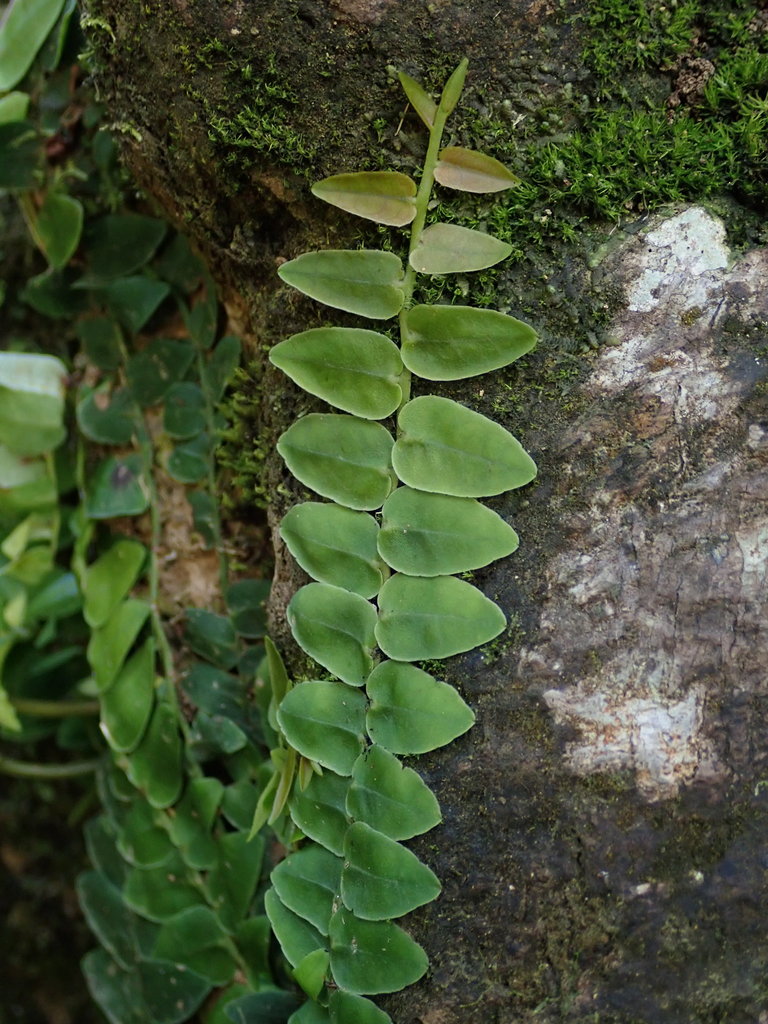
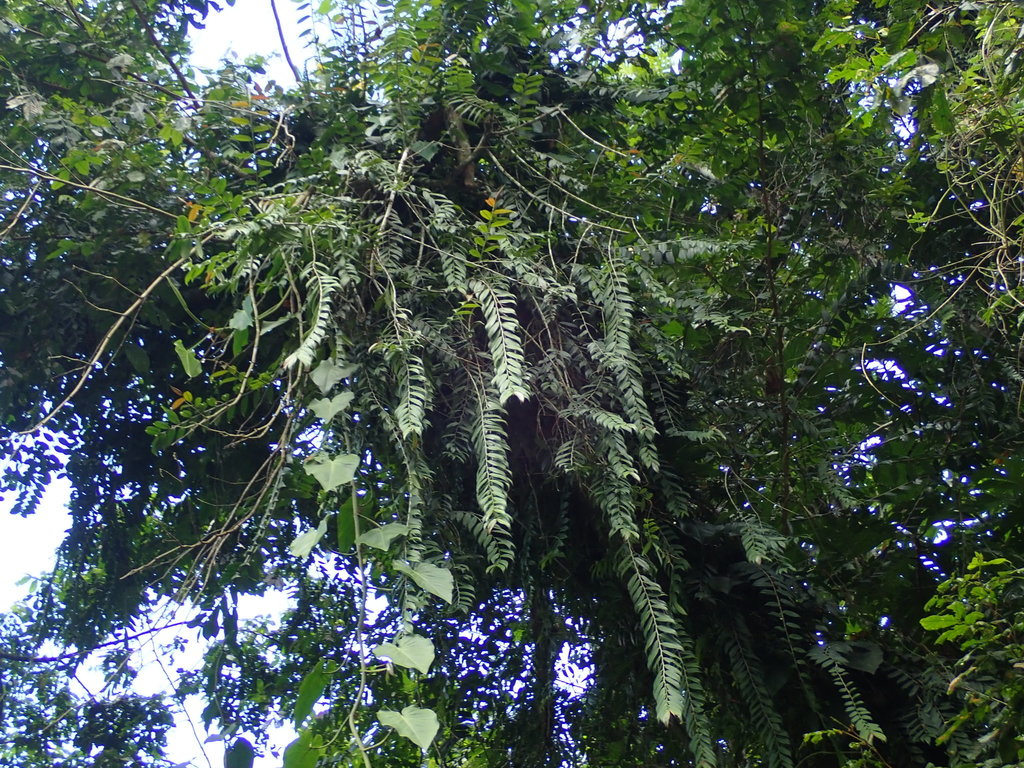
Marcgravia rectiflora, native across much of northern South America and the Caribbean, illustrates this transition particularly well, and the photographs below capture both ends of it on plants growing wild in Puerto Rico. The juvenile form displays leaves under one inch in length, tightly shingled in two parallel rows and pressed flat against the bark of the host tree. The mature form on the same species produces woody, free-hanging branches with elongated, leathery leaves several inches long; flowering occurs only at this stage. Marcgravia umbellata, a Caribbean and Central American species, follows the same pattern in cultivation, and its juvenile shingling growth remains among the most ornamental in the genus.
Juvenile shingling form — leaves pressed flat against bark. Photo by Daniel Cahen, licensed under CC BY 4.0.Mature pendulous form — long branches with elongated leaves, reproductive stage. Photo by Daniel Cahen, licensed under CC BY 4.0.
The transition between the two forms is generally one-directional. Once a stem has matured into the adult form, it does not revert to juvenile growth, which is one of the reasons sustained humidity and a proper climbing substrate matter so much.
Marcgravia Terrarium Care
Cultivation of Marcgravia in terraria is straightforward provided the environmental requirements are met. The genus thrives in conditions that mirror its native rainforest understory: ambient humidity sustained between 70 and 100 percent, gentle and consistent air circulation, and moderate, indirect lighting. Direct or high-intensity lighting will cause foliage to bleach or scorch, and the shingling juvenile growth that most growers want to encourage will fail to develop properly under inadequate humidity. Substrate selection should favor moisture retention with adequate aeration; sphagnum-based mixes perform well, as does ABG mix supplemented with additional sphagnum. Personally, I prefer to root new cuttings on top of sphagnum. Marcgravia will climb almost any moist, textured vertical surface, and many growers train the plant onto cork bark, tree fern panels, or sphagnum-covered foam. Once established on such a surface, the juvenile growth produces the dense, pressed-leaf appearance that defines the genus in vivarium culture. Temperature requirements are forgiving for most species in cultivation; standard tropical conditions between 65 and 85 degrees Fahrenheit are suitable, and prolonged exposure below 55 degrees should be avoided.
Common Marcgravia Care Mistakes
The two most frequent issues encountered by growers are insufficient humidity and inadequate vertical surface area. Marcgravia will not succeed in producing its characteristic shingling juvenile growth in dry conditions, and instead the growth tips will dry and shrivel. Sustained high humidity is therefore the single most important factor in achieving the appearance that draws most growers to the genus in the first place. Lack of a suitable climbing substrate is the second common issue. The plant requires something moist, textured, and vertical to grow up. Excessive light produces a third recurring problem, with foliage becoming bleached or yellowed when exposed to higher intensities than the species tolerates. If the leaf coloration appears washed out, light intensity should be the first variable evaluated.
Getting Started With Marcgravia
For growers approaching Marcgravia for the first time, the most reliable course of action is to begin with a healthy, immature cutting and a species known to be forgiving in cultivation. Juvenile growth establishes most readily on a ground/terrestrial surface, with the growth tip pointing to the vertical surface that you wish for it to climb. Several species are well represented in the hobby and reasonably tolerant of variation in conditions; others are more demanding and best approached after some experience with the genus. Each of our listings includes notes on the individual species and its typical behavior in cultivation. Availability changes regularly, and the link below will reflect what is currently in stock.
If you are uncertain which species would be most appropriate for your setup, please reach out through our contact page. We are happy to recommend something suited to both your experience level and the conditions you are working with.
Every specimen is personally propagated and tended in our greenhouse in Palm Bay, Florida. Nothing is sourced from outside wholesalers.
- Brandon
References
Carballo-Arce, A.F., Villegas-Peñaranda, L.R., Garro-Álvarez, R.E., Alfaro-Ureña, Y., Sandoval-Barrantes, M., Mullally, M., & Arnason, J.T. (2025). Mini review: Ethnopharmacology and phytochemistry of the tropical American family Marcgraviaceae. Frontiers in Pharmacology, 16, 1622814.https://doi.org/10.3389/fphar.2025.1622814
Simon, R., Holderied, M.W., Koch, C.U., & von Helversen, O. (2011). Floral acoustics: conspicuous echoes of a dish-shaped leaf attract bat pollinators. Science, 333(6042), 631–633.https://doi.org/10.1126/science.1204210
Marcgravia are not particularly difficult once humidity and a climbing surface are in place. The two requirements that trip most growers up are sustained humidity above 70 percent and a moist, textured vertical substrate for the juvenile shingling growth to attach to. Without those, the plant will limp along rather than develop the appearance most people are growing it for. With them in place, the genus is forgiving of moderate variation in temperature and routine.
How much light do Marcgravia need?
Moderate, indirect lighting. The genus evolved in shaded rainforest understory and on lower trunks, so direct or high-intensity terrarium lighting will bleach or scorch the foliage. If the leaf coloration begins to wash out, light intensity is the first variable to evaluate. A standard terrarium LED running at modest output, or placement away from the brightest portion of the tank, generally produces the best leaf color.
What substrate is best for Marcgravia?
Substrate selection should favor moisture retention with adequate aeration. Sphagnum-based mixes perform well, as does ABG mix supplemented with additional sphagnum. New cuttings root readily directly on top of damp sphagnum, with the growth tip oriented toward whatever vertical surface the plant will eventually climb. Cork bark, tree fern panels, and sphagnum-covered foam are all suitable climbing substrates once the plant is established.
How often should I water Marcgravia?
Marcgravia are hemiepiphytes, so ambient humidity matters more than direct watering of the substrate. The base substrate should remain consistently moist but not waterlogged, and the climbing surface should be kept damp through misting or an automated system. In a properly sealed terrarium with sustained humidity above 70 percent, supplemental watering is needed only when the surface begins to dry. Stagnant air should be avoided; gentle, consistent circulation prevents fungal issues without drying the plant.
Why is my Marcgravia leaves shriveling or drying?
Drying or shriveling growth tips almost always indicate insufficient humidity. Marcgravia will not produce its characteristic shingling juvenile growth in dry conditions, and the leading edge of new growth is the first part of the plant to suffer. If humidity is confirmed to be in range, the next variables to check are airflow that is too aggressive and a climbing surface that has dried out. Restoring sustained humidity above 70 percent will generally allow the plant to resume normal growth, though damaged tips will not recover and new shoots will need to take their place.

Leave a comment